BRIAN KENNEDY
Biotechnology
Dr. Brian Kennedy is an internationally recognized scientist, longevity researcher, biotechnology leader, and entrepreneur widely regarded as one of the leading figures in the global aging and healthspan research movement. Over the course of his distinguished career, Dr. Kennedy has helped pioneer foundational scientific discoveries linking cellular signaling pathways, metabolism, and nutrient sensing to aging and longevity, contributing to major advances in the modern understanding of age related disease and lifespan regulation.
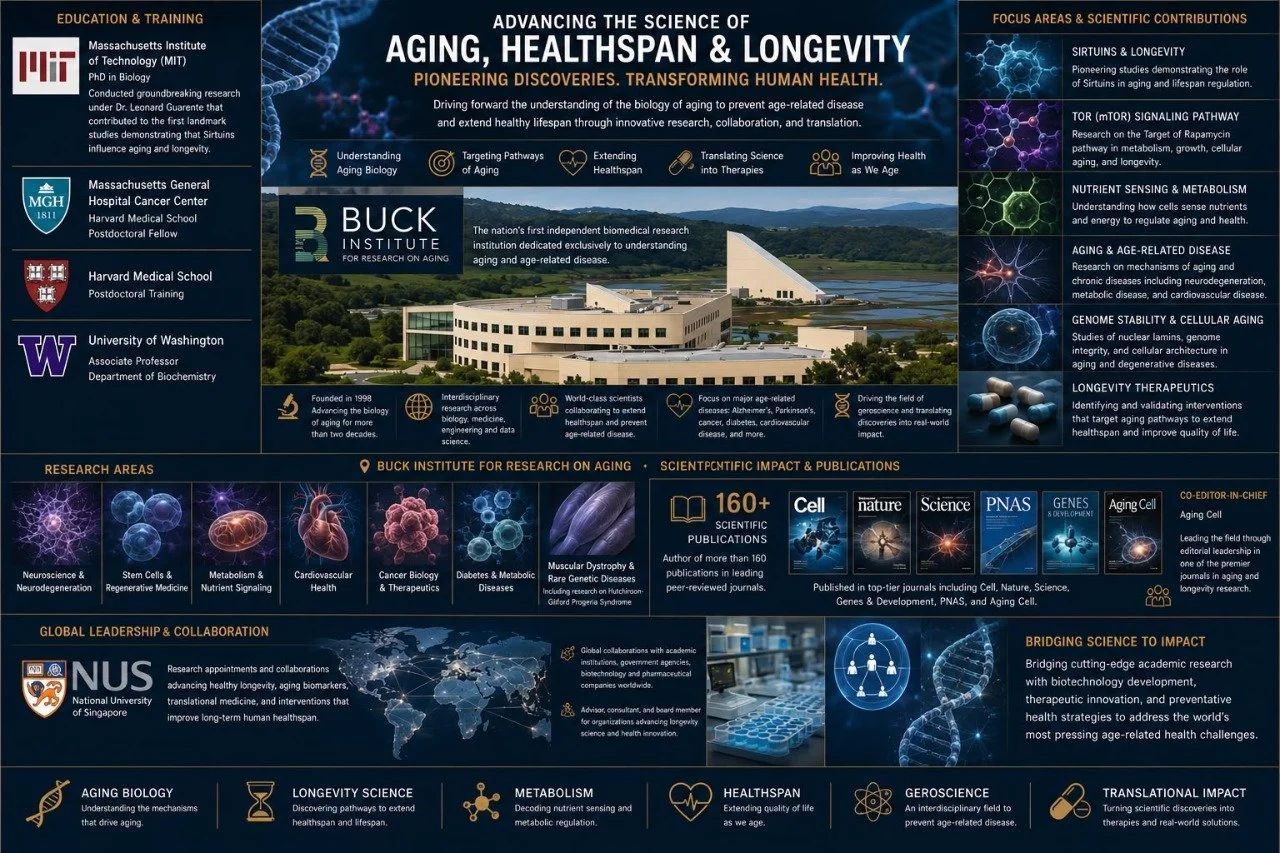
Dr. Kennedy earned his PhD in Biology from the Massachusetts Institute of Technology (MIT), where he conducted groundbreaking research under renowned aging researcher Dr. Leonard Guarente. During his graduate work, Dr. Kennedy contributed to the first landmark studies demonstrating that a class of proteins known as Sirtuins influence aging and longevity. These discoveries became highly influential within the global scientific community and helped catalyze significant research and investment into aging biology, metabolism, longevity therapeutics, and age related disease intervention strategies.
Following MIT, Dr. Kennedy completed postdoctoral training at the Massachusetts General Hospital Cancer Center, affiliated with Harvard Medical School, one of the world’s leading biomedical research institutions. He later joined the faculty at the University of Washington, where he became an Associate Professor in the Department of Biochemistry and continued conducting influential research involving aging biology, metabolism, nutrient signaling pathways, and longevity mechanisms.
Dr. Kennedy later became President and Chief Executive Officer of the Buck Institute for Research on Aging, the nation’s first independent biomedical research institution dedicated exclusively to understanding aging and age related disease. Under his leadership, the Buck Institute significantly expanded its scientific reputation and helped accelerate the emergence of the modern geroscience movement, an interdisciplinary field focused on understanding how the biology of aging drives chronic disease. During his tenure, the institute further established itself as one of the world’s premier centers for aging, longevity, neuroscience, metabolism, stem cell, and regenerative medicine research.
The Buck Institute has become internationally recognized for advancing research into the biological mechanisms underlying aging and chronic disease, including Alzheimer’s disease, Parkinson’s disease, cancer, diabetes, cardiovascular disease, and neurodegeneration. The institute has brought together leading scientists across multiple disciplines focused on extending healthspan and developing therapeutic approaches designed to improve quality of life during aging.
A major focus of Dr. Kennedy’s scientific career has involved the Target of Rapamycin (TOR) signaling pathway, one of the most important biological pathways associated with aging, metabolism, cellular growth, and nutrient sensing. Research involving TOR and the drug rapamycin generated major scientific interest after studies demonstrated significant lifespan extension in animal models, helping establish mTOR biology as one of the central pillars of modern longevity science. Dr. Kennedy’s work has contributed substantially to understanding how pathways such as TOR, Sirtuins, and nutrient signaling systems may potentially be manipulated to address age related disease and improve long term healthspan.
His laboratory has also explored diseases involving accelerated aging and cellular degeneration, including cardiovascular disease, metabolic syndrome, type II diabetes, muscular dystrophy, dilated cardiomyopathy, and Hutchinson-Gilford Progeria Syndrome, a rare disease associated with premature aging. His work investigating nuclear lamins and cellular architecture has contributed to broader understanding of cellular aging, genome stability, and degenerative disease mechanisms.
Over the course of his career, Dr. Kennedy has authored more than 160 scientific publications appearing in many of the world’s leading scientific journals, including Cell, Nature, Science, Genes & Development, and PNAS. He has also served as Co-Editor-in-Chief of Aging Cell, one of the leading journals in aging and longevity research. His scientific contributions have helped shape major areas of modern aging biology, longevity therapeutics, metabolic health, and translational geroscience research.
In recent years, Dr. Kennedy has become an influential figure within the rapidly expanding global longevity and biotechnology sectors, helping bridge cutting edge academic science with biotechnology commercialization, therapeutic development, and preventative health initiatives. He has served as an advisor, consultant, board member, and collaborator with multiple biotechnology and pharmaceutical organizations focused on aging, metabolism, health optimization, and next generation longevity interventions.
Dr. Kennedy has also held leadership and research roles internationally, including appointments associated with the National University of Singapore, where he has contributed to expanding global research initiatives focused on healthy longevity, aging biomarkers, translational medicine, and interventions designed to improve long term human healthspan. His work continues to influence scientific, clinical, and commercial efforts aimed at understanding and potentially modifying the biological processes of aging itself.